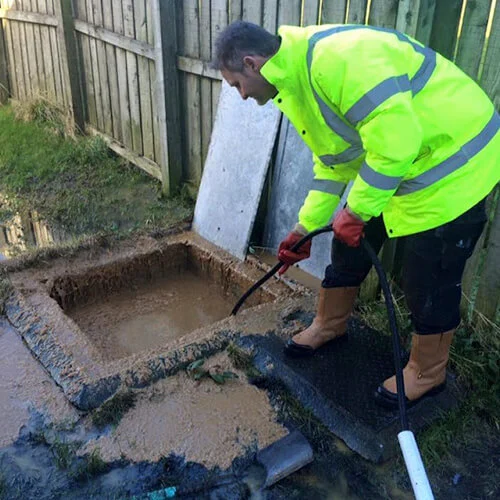


At JSL Drainage, we’ve been helping homeowners and businesses with everything from drain excavation to drain repairs in Glasgow for over a decade. Whether it’s a blocked drain in Glasgow, a broken drain pipe in Glasgow, or an emergency drain unblocking job in the West End, one common feature that keeps appearing in every system is the drain inspection chamber.
In this blog, we’ll demystify this often overlooked but essential component of your drainage system. You’ll learn what an inspection chamber is, how it works, where it should be installed, and how it differs from a manhole. Plus, we’ll cover types, depths, and maintenance, all drawn from years of hands-on experience as a local drainage company working across North Glasgow, West End Glasgow, and beyond.

An inspection chamber is a covered access point in your underground drainage system. It allows engineers and technicians to inspect, maintain, or clean the network of drainpipes running beneath your property. These chambers are usually found where drainpipes meet or change direction and are shallow enough to provide rod or camera access.
They serve as vital checkpoints that eliminate the need for large-scale drain excavation in Glasgow. Instead of digging up your garden or driveway every time there’s a suspected blockage, a drain engineer from a recommended drainage company like JSL Drainage can access your system quickly through the chamber and address the issue efficiently.
A manhole is another type of access point, but it’s significantly larger and deeper than an inspection chamber. While inspection chambers are typically up to 1.2 metres deep and only wide enough for tools or cameras, manholes are deep and spacious enough for a person to enter physically.
These structures are primarily found in public or commercial sewer systems. If you’re dealing with an issue on public land or a large-scale property, chances are you’re dealing with a manhole, not an inspection chamber.
Unlike the lightweight covers used for inspection chambers, manholes use heavy-duty cast iron covers capable of supporting heavy traffic, especially in roads and public spaces.
Although both provide access to underground drainage systems, inspection chambers and manholes serve different purposes and vary in size, depth, and use.
If you’re unsure which applies to your property, our team at JSL Drainage, a trusted drainage company near you, can advise and assist.
Though it may seem like a simple feature in a drainage system, an inspection chamber is made up of several key components that each play a vital role in ensuring efficient and reliable performance.
Forms the foundation of the unit. It’s where the incoming and outgoing drainage pipes are connected, acting as the main flow channel for wastewater. Most modern bases are pre-moulded with specific inlets and outlets, which makes it easier to connect pipes during installation. This design ensures that wastewater flows in the correct direction with minimal resistance, reducing the chances of blockages and backflow.
Found above the base, these modular sections can be stacked to adjust the height of the chamber. These are especially helpful when the chamber needs to be installed under features like driveways, patios, or garden lawns. By extending the risers, engineers can ensure the access cover remains flush with the surface, allowing for easy access without compromising aesthetics or function.
Found between each riser and the base, they are installed to create a watertight seal. This prevents wastewater from leaking into the surrounding soil, which could otherwise cause subsidence or ground contamination. These seals are crucial for maintaining the integrity of the drainage system and protecting the environment around it.
Sit at the top of the chamber. These are available in various materials, including plastic, galvanised steel, or cast iron, depending on the installation environment. For pedestrian areas, a lightweight cover may suffice, but for driveways and roads, a heavy-duty version is necessary. The frame ensures the cover stays securely in place while also supporting the weight of whatever is above it, whether that’s foot traffic or a vehicle.
The actual drainage pipes that feed into and out of the inspection chamber. These pipes guide wastewater from your home’s fixtures into the underground drainage system, ensuring continuous flow and efficient waste management. Any problems within these pipes, such as a broken drain pipe, can often be diagnosed and resolved through the chamber access.

The fundamental purpose of an inspection chamber is to allow safe, easy access to your underground drainage system without the need for disruptive or expensive drain excavation. These access points are essential for maintaining the long-term health of your drainage network.
By providing a direct route into your pipework, inspection chambers make it possible to carry out crucial tasks like inspections, cleaning, and repairs. Whether it’s a routine maintenance check using drain CCTV survey equipment or a more urgent situation like a blocked drain in Glasgow, an inspection chamber allows drain engineers from drainage contractors in Glasgow to identify the issue quickly and with minimal disruption to your property.
In many cases, these chambers are used for inserting drain rods or drain jetting equipment to dislodge obstructions. They also serve as ideal locations for placing cameras during drain surveys, especially when investigating hidden problems like leaks or tree root intrusion.
For homeowners, one of the biggest advantages of having a well-placed inspection chamber is peace of mind. If you’re dealing with recurring drainage issues or suspect you need a drainage repair in Glasgow, the expert team at JSL Drainage will assess and fix the problem quickly, without tearing up your driveway or garden.
Not all inspection chambers are the same. Different drainage systems, locations, and usage needs will call for different types of chambers, each offering its benefits and limitations.
If you’re unsure which type your project requires, our team at JSL Drainage, a recommended drainage company in Glasgow, can assess your system and help you make the right decision.
An inspection chamber acts as an underground checkpoint in your drainage system. It’s like a small access room where several pipes meet. Wastewater flows through this chamber in a controlled and visible way.
Water enters through the inlet pipes and exits via the outlet pipe, usually heading to the main sewer. If there’s a build-up of waste, debris, or roots, these can be spotted quickly. Tools like rods or cameras can be inserted through the chamber before bigger issues develop.
When unblocking blocked drains in Glasgow, our team at JSL Drainage often starts with the nearest inspection chamber. It gives us direct access to the blocked section, allowing us to use drain rods or high-pressure drain jets efficiently.
For hidden issues, like a broken drain pipe that Glasgow homeowners might not notice, a chamber is essential. It lets us run a drain CCTV survey without digging, saving time and money.
You’ll commonly find drainage inspection chambers strategically placed around properties, both residential and commercial. The exact location depends on the layout of your drainage system and how your pipework is routed.
A typical spot is at a pipe junction or where two or more pipes meet. This allows drain engineers to inspect the intersection where blockages are more likely to occur. Another frequent location is at a change in direction in the pipework, such as where pipes turn a corner or alter in gradient, because these changes can cause flow issues or debris accumulation.
You may also find chambers installed near the property boundary, especially where private drains connect to public sewers. This is a legal requirement in some cases and helps water authorities access your drainage connection without entering your property.
Installers often place inspection chambers under driveways, patios, or garden spaces, using risers to raise the cover so it sits flush with the surface. Inside the property, they usually position chambers near kitchens or bathrooms, where wastewater exits the building.
If you’re undertaking a renovation, planning an extension, or installing a new system in North Glasgow or the West End, our team at JSL Drainage, a drain company West End Glasgow trusts, can help you determine the most efficient and accessible locations.

Installing an inspection chamber is a smart move at several stages of a property’s life, particularly when laying a new drainage system. It offers easy future access and ensures compliance with UK building regulations.
If you’re converting or extending your property, it’s often necessary to reroute or expand your drainage network. Adding a chamber during this process not only simplifies future maintenance but also increases the value and resilience of your home.
If you’re facing recurring drainage issues, such as frequent blockages, slow-draining water, or even visible signs of a broken drain pipe in Glasgow, installing an inspection chamber can make troubleshooting and repair work significantly easier and more cost-effective.
Lastly, if your current system lacks access points or if your existing inspection chambers are damaged, outdated, or too shallow, upgrading or installing a new chamber is strongly recommended. It’s an investment that can prevent expensive drain excavation in Glasgow down the line.
Local water authorities set strict standards that an adoptable inspection chamber must meet. Builders typically install these in new housing estates or developments where the drainage system will eventually transfer to public authorities for ongoing maintenance. These chambers must use approved materials, meet specific pipe size requirements, and follow regulated construction depths.
On the other hand, property owners install non-adoptable inspection chambers for private use. These chambers give more flexibility with materials and placement, making them a more cost-effective option for individual homes. You’ll often find them in gardens, under driveways, or within private property boundaries.
Choosing the right type can be tricky, especially during renovations or new builds. That’s why many homeowners turn to a drainage company near you, like ours JSL Drainage, to make sure the system stays compliant and performs reliably.
Most standard inspection chambers are designed to be installed to a maximum depth of 1.2 metres. This is deep enough to service most domestic drainage networks, offering sufficient access for CCTV drain surveys, drain jetting, and drainage repairs without requiring human entry.
If your drainage system runs deeper than this, perhaps due to property elevation or gradient requirements, then a manhole may be more appropriate, as it allows for manual entry and more robust construction.
Always consult a professional drainage contractor in Glasgow, like JSL Drainage, before planning your installation. Depths, gradients, and access all play a role in the long-term success of your system, and proper planning will prevent costly rework or non-compliance with building standards.
Inspection chambers may not be glamorous, but they are essential. They save time, money, and hassle when it comes to maintaining and repairing drainage systems. Whether you’re dealing with a blocked drain in Glasgow, planning new pipework, or require urgent drain repairs, knowing the location and function of your inspection chamber makes a world of difference.
At JSL Drainage, we specialise in all aspects of drainage repair services in Glasgow. From unblocking blocked drains to full drain excavation Glasgow-wide. We’re proud to be the drainage company that West End of Glasgow, North Glasgow and beyond trusts. Contact us today!